
Product Trivia
Personalized messaging campaigns can increase customer engagement by up to 45% compared to generic ads.
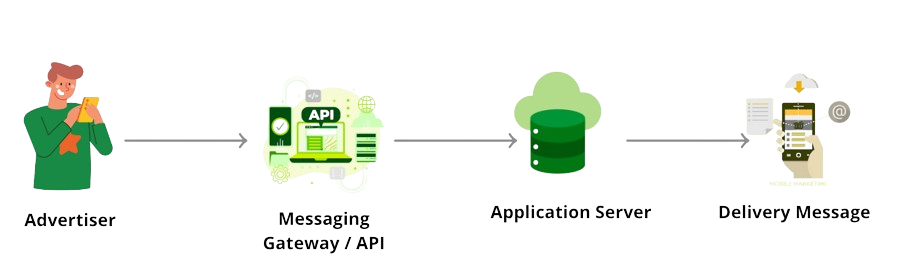
How to Advertising Messaging Work
Use Cases
Advertising messaging is used to send targeted promotional content—such as product launches, special offers, or personalized discounts—directly to consumers’ mobile devices. It helps brands boost engagement and conversions by reaching the right audience at the right time through high-visibility channels like SMS, WhatsApp, and in-app notifications.
Banking and Finance
Banking and Finance
Banking and Finance
Frequently Ask Question (FAQ)
What is Advertising Messaging?
Advertising Messaging refers to the delivery of promotional or marketing messages to mobile users through channels such as SMS, RCS, WhatsApp, push notifications, or in-app messaging using automated marketing platforms or messaging gateways.
How does Advertising Messaging differ from A2P transactional messaging?
Advertising Messaging is focused on promotional content, segmentation, and campaign broadcasting, while A2P transactional messaging delivers critical system events such as OTPs or alerts. Advertising routes often support high volume but may have stricter compliance and opt-in rules.
Which delivery channels are supported?
Most platforms support:
SMS Marketing (Bulk SMS)
RCS Business Messaging
WhatsApp Promotional Templates (dependent on region)
Push Notifications
Viber/OTT promotional messages
Email-to-SMS or hybrid marketing campaigns
What protocols are used for sending Advertising Messages?
Messages can be delivered through HTTP/REST APIs, SMPP binds, RCS RBM APIs, WhatsApp Business Cloud API, or platform-specific SDKs for push notification channels (FCM/APNS).
How is targeting and segmentation handled?
Advanced platforms support:
Audience segmentation using demographics, location, or behavior
Contact list management
Dynamic attributes (e.g., last purchase date)
API-based campaign triggers via CRM or business systems
Are there compliance requirements for Advertising Messaging?
Yes. Advertising Messaging must follow:
Opt-in/opt-out regulations
DND (Do Not Disturb) policies
Operator and channel-specific guidelines
Data protection laws such as GDPR or local regulatory requirements
The platform typically enforces throttling and validation to avoid spam violations.
How are delivery reports (DLRs) handled for marketing campaigns?
DLRs are provided via callback URLs, downloadable reports, or dashboard analytics. Reports may include:
Delivered / Pending / Failed
Operator response codes
Click-through tracking (for OTT/RCS)
Engagement analytics (if supported)
Can Advertising Messaging handle large-scale broadcast traffic?
Yes. Marketing gateways support high throughput using distributed queue systems, auto-scaling workers, and multi-route routing logic capable of sending millions of promotional messages.
How can message personalization be implemented?
Personalization can be done using:
Template variables (name, product, location, etc.)
Dynamic content injection via API
CRM-integrated triggers
A/B testing for content optimization
What is required to integrate Advertising Messaging into my system?
You need:
API access (REST/SMPP) or dashboard login
A verified sender ID, short code, or messaging profile
Valid opt-in user database
Optional DLR webhook endpoint
Support for template-based messaging (WhatsApp/RCS/SMS)
Compliance adherence for marketing regulations