

A2P Messaging

Product Trivia

Over 65% of global businesses connect with customers using A2P Messaging — from OTPs to delivery alerts — all powered by smart applications, not people!

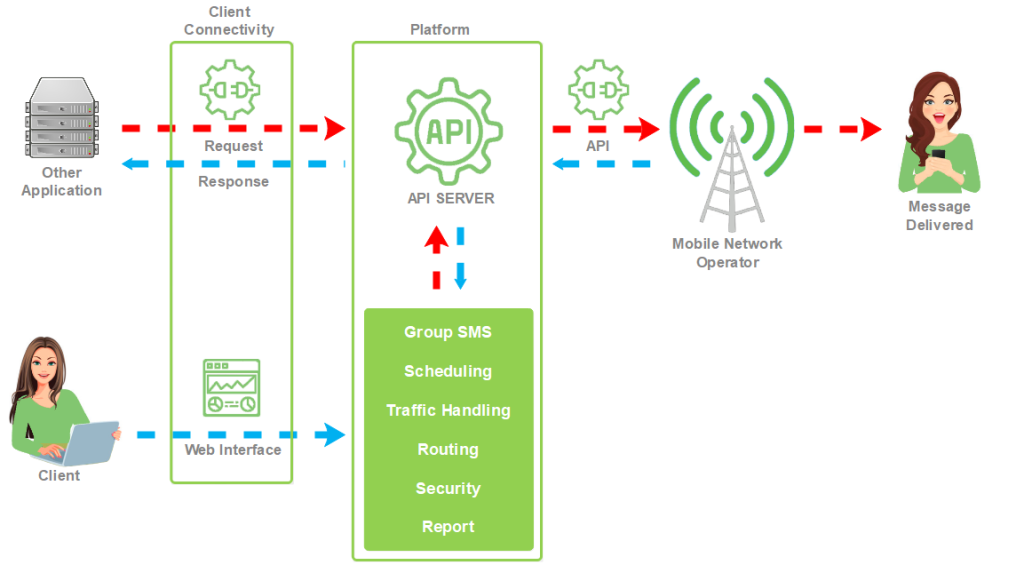
How to A2P Messaging Work

Use Cases

Over 65% of global businesses connect with customers using A2P Messaging — from OTPs to delivery alerts — all powered by smart applications, not people!

Banking and Finance

Sending OTPs, transaction alerts, and fraud notifications.

Banking and Finance

Sending OTPs, transaction alerts, and fraud notifications.

Banking and Finance

Sending OTPs, transaction alerts, and fraud notifications.

Frequently Ask Question (FAQ)

What is A2P Messaging from a technical perspective?

A2P (Application-to-Person) Messaging refers to automated message delivery initiated by software applications via telecom operator gateways using protocols such as SMPP, HTTP/REST APIs, or SS7 signaling.

A2P traffic typically utilizes SMPP, HTTP/REST, MM7, or operator-direct connections. Some providers also support WebSocket and HTTPS callbacks for delivery reports (DLRs).

Messages are routed through multi-tier gateways using priority queues, load balancers, and intelligent routing engines that select operator routes based on cost, latency, and real-time delivery performance.

A2P platforms often support TLS encryption, IP whitelisting, HMAC signatures, OAuth or API key authentication, anti-spam filters, and real-time fraud detection for SIM-box or grey-route activity.

DLRs are received from operators and forwarded to clients through callback URLs (webhooks) or API endpoints. Reports include status codes such as “DELIVERED”, “FAILED”, or “EXPIRED” with detailed timestamps.

Yes. A2P platforms are designed with scalable queuing systems, distributed processing nodes, and auto-scaling infrastructure capable of handling millions of messages per minute depending on capacity.

A2P supports GSM-7, UCS-2, and UTF-8 encodings. Long messages are handled through concatenation (UDH) or segmentation, depending on operator support.

The routing engine automatically switches to backup routes using predefined route priorities or real-time health checks that detect latency spikes, delivery anomalies, or route failures.

Throughput is controlled at the account, gateway, or operator level. Clients may receive defined TPS (transactions per second) limits, adjustable based on agreements or traffic type (OTP vs. marketing).

Developers need API credentials, access to documentation, an endpoint for DLRs if required, and adherence to protocol specifications such as SMPP bind parameters or REST API request structures.