
Product Trivia
Rich Media Messaging allows businesses to send images, videos, buttons, and carousels — all inside a single message. It’s like running a mini ad campaign straight in your customer’s inbox!
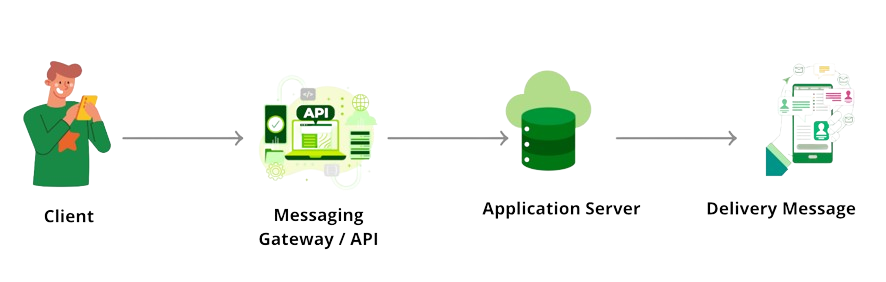
How to Rich Media Messaging Work
Use Cases
Rich Media Messaging allows businesses to send visually engaging, interactive messages with images, videos, and action buttons. It enhances customer experience by delivering richer content and driving higher engagement than standard text messages.
Banking and Finance
Banking and Finance
Banking and Finance
Frequently Ask Question (FAQ)
What is Rich Media Messaging?
Rich Media Messaging refers to communication channels that support multimedia content such as images, videos, audio, carousels, buttons, and interactive cards. Common channels include RCS, WhatsApp, Viber, LINE, and in-app messaging.
Which channels support rich media content?
Supported channels typically include:
RCS Business Messaging (RBM)
WhatsApp Business API
Viber Business Messages
LINE Messaging API
Facebook Messenger
In-app messaging (SDK-based)
Feature support depends on each channel’s capabilities.
What content types can be delivered?
Rich Media Messaging supports:
Images (JPG/PNG/WebP)
Videos (MP4)
Audio files
Documents (PDF, DOCX)
Interactive buttons (Call-to-Action, Quick Reply)
Carousels and rich cards
Location sharing and map previews
What protocols are used for sending rich media messages?
Depending on the channel:
RCS: RBM APIs (Google) via REST
WhatsApp: Cloud API (Meta) via HTTPS
Viber/OTT: REST APIs
In-app: SDKs or custom WebSocket/REST frameworks
Media files are often uploaded to a media endpoint before sending.
How are media assets handled?
Most platforms require media to be:
Uploaded to a media hosting API
Validated for file size, MIME type, and format
Cached with a media ID for reuse
Some channels have strict size limits (e.g., WhatsApp ≤ 16MB).
Are there limitations or compliance rules for rich media messaging?
Yes. Restrictions include:
Template approval rules (WhatsApp/RCS)
Content policies for advertising or sensitive topics
File size and dimension limits
Region-specific regulatory requirements
Violations may lead to message rejection.
How are delivery and engagement metrics tracked?
Rich media channels often provide advanced analytics:
Delivery & read receipts
Button click tracking
Carousel navigation data
Session duration and interaction logs
These are delivered via webhooks, callback URLs, or analytics dashboards.
Can rich media campaigns scale for high-volume traffic?
Yes. Platforms use:
Distributed message queues
Auto-scaling message dispatchers
Media caching layers
Multi-channel routing with fallback (e.g., RCS → SMS)
This ensures stable delivery even with large campaign loads.
How does personalization work for rich media content?
Personalization can be applied through:
Template variables (e.g., name, transaction details)
Dynamic card generation via API
Conditional content blocks per user segment
CRM-based triggers for targeted delivery
What is required to integrate Rich Media Messaging into my system?
You need:
API credentials for the chosen channel
Access to media upload endpoints
A verified business profile (RCS/WhatsApp/Viber)
A webhook URL for receiving delivery & interaction events
JSON-based template structures for cards, buttons, or interactive flows