

Product Trivia
WhatsApp’s end-to-end encryption ensures every authentication session remains private and secure.
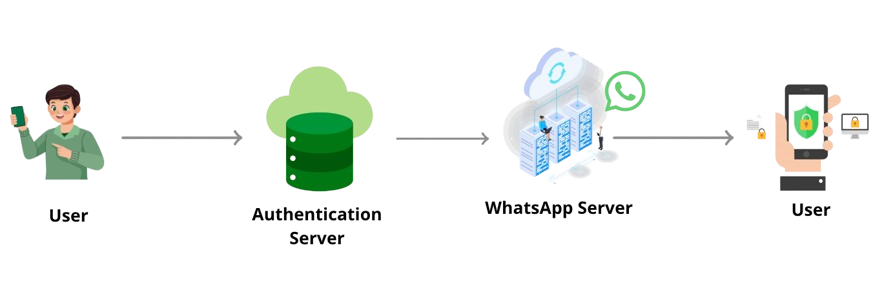
How to WhatsApp Authentication Work
Use Cases
WhatsApp Authentication enables businesses to securely verify users by delivering one-time passwords (OTPs) or authentication codes directly through WhatsApp. It offers faster delivery, higher visibility, and improved reliability compared to traditional SMS, helping ensure a smooth and trusted user verification experience.
Banking and Finance
Banking and Finance
Banking and Finance
Frequently Ask Question (FAQ)
What is WhatsApp Authentication?
WhatsApp Authentication uses WhatsApp Business API/Cloud API to send verification codes (OTP), login confirmations, and account authentication messages to users through secure, high-delivery messaging templates.
How does WhatsApp Authentication compare to SMS OTP?
Compared to SMS:
Higher delivery accuracy (less filtering, fewer routing failures)
End-to-end encryption
Interactive templates (buttons, autofill)
Works on data networks, even when SMS is unreliable
However, WhatsApp requires users to have an active WhatsApp number.
What message formats are supported for authentication?
WhatsApp supports the official Authentication Template, which includes:
One-time password (OTP)
Auto-fill code format allowing OS to detect and pre-fill the code
Optional expiry time and login context
Are message templates required for authentication?
Yes. Authentication messages must use pre-approved authentication templates provided by Meta. These templates cannot contain promotional or marketing content.
Example fields:
codeexpiry_minutesapp_name
How is security handled in WhatsApp Authentication?
WhatsApp provides:
End-to-end encryption
Secure HTTPS API communication
HMAC verification for webhooks
Strict phishing and spoofing protection
Additional security depends on the implementer’s OTP verification logic.
What APIs or protocols are used?
WhatsApp Authentication uses:
Cloud API (HTTPS/REST) – Recommended by Meta
On-premise WhatsApp Business API
Webhook callbacks for delivery status and message events
Media endpoints are not required for OTP delivery.
What are the delivery and throughput capabilities?
WhatsApp OTP delivery is typically within 1–5 seconds.
Throughput depends on business tiers but is generally sufficient for high-volume authentication flows.
API supports:
High TPS (transactions per second)
Parallel message dispatching
Automatic scaling based on quality rating
How are delivery statuses tracked?
WhatsApp provides real-time callbacks for:
Sent
Delivered
Read
Failed (with operator or WhatsApp error codes)
These can be captured via webhook and logged for auditing or analytics.
Are there restrictions for authentication messages?
Yes. Meta has strict rules:
Templates must not contain marketing content
OTP must be single-purpose (verification, login, signup)
No misleading or sensitive content
User must have WhatsApp activated on the number
What is required to integrate WhatsApp Authentication?
You will need:
A WhatsApp Business Account (WABA)
A verified Facebook Business Manager
A linked phone number
Cloud API access token
A verified authentication template
A backend service to generate and validate OTP codes
A webhook endpoint for receiving DLRs (delivery receipts)